
A few years back I watched a local coffee roaster burn through almost her entire first-year marketing budget on Instagram ads. Nice photos, decent copy, a modest little following building up. Sales barely moved. When I asked what made her different from the three other roasters within a mile, she paused for a long time and finally said, "we roast in small batches." So does everyone else on that street. She knew it too, the second it came out of her mouth.
That's not really a marketing problem. It's a brand problem wearing a marketing costume. And it's one of the most common mistakes business owners make before they ever open an ad account.
What Is a Brand Strategy?
At its core, brand strategy is the long-term plan behind how a company positions itself: its messaging, values, target audience, and the thing that actually makes it different from the next guy. Everything downstream gets built on its website copy, paid campaigns, even how someone on your sales team talks about the business on a call they didn't plan for.
Marketing strategy is a different layer entirely. It's the execution of the specific channels, campaigns, and content you use to get that brand message in front of the right people at the right moment, whether that's SEO, paid ads, email, or social.
Here's the short version: brand strategy figures out what you're saying and who you're saying it to. Marketing strategy figures out how loudly, and where.
Brand Strategy vs. Marketing Strategy: What's the Difference?
| Aspect | Brand Strategy | Marketing Strategy |
|---|---|---|
| What it's about | Positioning, values, target audience, brand voice | Channels, campaigns, content, digital marketing execution |
| How often it shifts | Rarely, maybe once every few years | Constantly, campaign to campaign |
| What it produces | Brand positioning, messaging framework, brand guidelines | Ads, content marketing, email sequences, conversion optimization |
| The question it answers | Why should anyone care? | How do we get in front of them, and how do we move them through the marketing funnel? |
Neither one substitutes for the other. Marketing running without a brand strategy underneath it tends to burn through budget without building lasting brand awareness. A brand strategy that never gets executed into a real marketing strategy just sits in a document nobody opens again.
Why Brand Strategy Matters Before You Spend on Marketing
Trust is the thing that actually drives purchase decisions, and trust doesn't come from a clever ad. It comes from consistency, repeated over time, across every touchpoint a customer has with your business. According to Edelman's Trust Barometer, trust remains one of the strongest drivers of purchasing decisions, which makes consistent brand messaging a genuine competitive advantage rather than a nice-to-have.
The financial case backs this up. Research from Lucidpress (now Marq), based on surveys of hundreds of brand management professionals, found that companies maintaining consistent brand presence across channels saw revenue increases ranging from roughly 23% up to 33%, depending on how disciplined the enforcement was. That's not a rounding error. For a mid-sized business, that gap can represent real, measurable revenue that has nothing to do with increased ad spend and everything to do with customers recognizing and trusting what they're seeing.
A few specific things tend to go wrong when marketing runs ahead of brand strategy:
- Your message ends up aimed at everyone, which means it lands with no one. Without a defined customer persona, copy drifts toward safe and general language that doesn't move anyone toward a decision. A real brand strategy forces the uncomfortable work of deciding who you're not for.
- Every campaign starts from a blank page. No brand voice, no messaging framework, no positioning to reference, and every new campaign gets rebuilt from instinct. That's slower and more expensive, whether you're paying an in-house team or an agency.
- Customer trust builds slower, if it builds at all. A formal website, a casual Instagram account, and a sales team saying something else entirely on calls create friction people notice even when they can't name it.
- Marketing spend stops compounding. A campaign with no brand strategy behind it might produce a decent week of traffic. It rarely builds customer loyalty, because there's nothing memorable left behind once the ad stops running. A defined brand strategy means every campaign reinforces the last one instead of starting the story over.
The Building Blocks of a Strong Brand Strategy
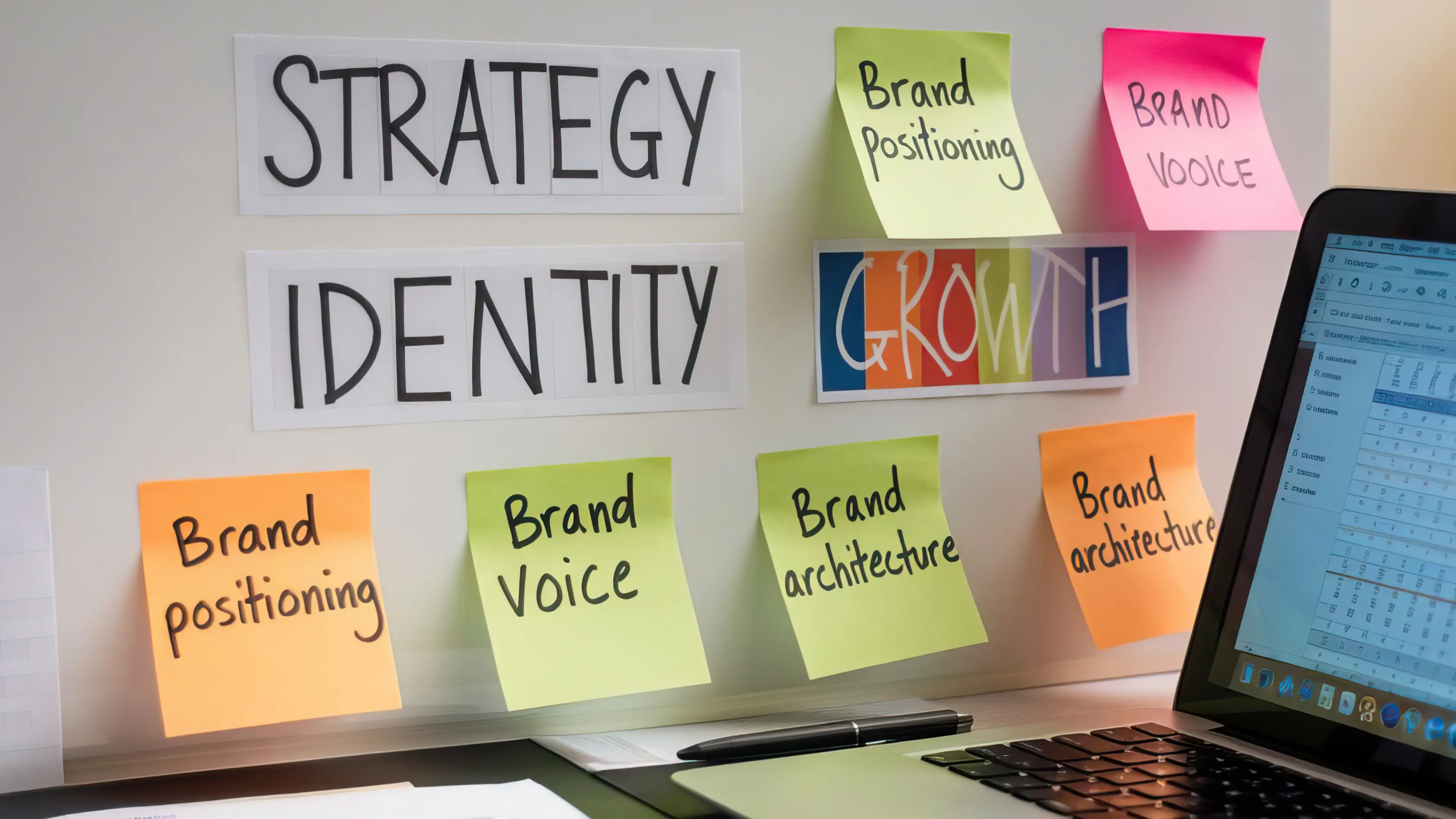
A brand strategy isn't a logo or a color palette; those come later as part of brand identity, the visual and verbal expression of the strategy underneath. A working brand strategy typically includes:
- Brand positioning – where you sit in the market relative to competitors, and why that spot matters to your audience
- Customer personas – detailed profiles of who you're actually trying to reach, built from real customer research rather than assumptions
- Value proposition – the specific, provable reason someone should choose you over an alternative
- Brand voice – the tone and personality your business uses consistently across every channel
- Competitive positioning – an honest read of how competitors describe themselves, so your messaging doesn't accidentally echo theirs
- Market research – ongoing insight into what your audience actually wants, not just what you assume they want
- Brand guidelines – the documented rules that keep everyone, from founders to freelancers, presenting the brand the same way
Once these pieces exist, your website copy, ad campaigns, and content marketing all pull from something solid instead of getting reinvented every time someone new sits down to write.
A Simple Brand Strategy Framework
- Define your mission. What is the business trying to accomplish, beyond making money?
- Identify your target audience. Build real customer personas based on interviews, not guesses.
- Research competitors. Map out how they position themselves and where the gaps are.
- Create your value proposition. State clearly and specifically why someone should choose you.
- Develop your messaging. Define your brand voice and the core themes your content will return to.
- Build your visual identity. Translate the strategy into logo, color, and design decisions, not the other way around.
- Align your marketing campaigns. Make sure every channel, from SEO to paid ads to email, reflects the same positioning.
This doesn't have to be a six-month process with a five-figure invoice attached. Smaller businesses can often work through the core of it in a handful of focused sessions. What matters more than the timeline is the order: strategy first, spend second.
Is Branding Different From Marketing?
Yes. Branding, or brand identity, is the visible and audible expression of your strategy: your logo, color palette, and tone of voice. Marketing is the activity of getting that brand in front of people through specific channels and campaigns. Branding shapes how people feel about you at every stage of the buyer journey; marketing is what actually moves them through the marketing funnel, from awareness to conversion. They work together, but they answer different questions.
Do Small Businesses Need a Brand Strategy?
Yes, arguably more than larger ones, since small businesses have far less room for wasted spend. Skipping brand strategy tends to show up later as:
- Messaging that shifts depending on which page a visitor lands on
- Constant rewrites of the "About" page because nothing ever quite feels right
- Ad campaigns pulling clicks but not conversions, because there's no clear customer persona or reason to buy behind them
- Competing on price, since without real differentiation, price becomes the only lever left
- Paying an agency or freelancer to guess at direction instead of working from a clear, strategy-backed brief
None of this sinks a business overnight. It's more like a slow tax on everything that follows, one that quietly makes customer experience and customer loyalty harder to build than they need to be.
When Should You Build (or Rebuild) Your Brand Strategy?
Ideally, before a single ad runs. In practice, a few moments make it unavoidable:
- Starting a new business, before spending on a website or a campaign
- Entering a new market or launching a product where the old positioning doesn't hold up
- Watching marketing underperform month after month despite decent creative and reasonable budget
- Preparing for a rebrand because the current identity no longer matches where the business has ended up
- Growing a team, so everyone works from the same understanding of what the brand actually stands for
DIY vs. Hiring a Branding or Marketing Agency
Not every business needs to hire an agency for this, but some signs suggest it's worth the investment:
- You've rewritten your messaging more than twice in the past year and it still doesn't feel right. That's usually a sign the underlying strategy, not the wording, is the problem.
- Your team can't agree on who the business is actually for. An outside perspective, backed by real market research, tends to cut through internal disagreement faster than another internal meeting.
- Marketing campaigns keep underperforming despite solid execution. If the ads are well made but still flat, the issue is usually positioning, not creative.
- You're scaling fast and don't have the internal bandwidth to run structured customer interviews and competitive analysis alongside the day-to-day.
A branding agency is generally worth bringing in first, to establish positioning, messaging, and value proposition. A marketing agency or in-house marketing hire makes more sense once that foundation exists and the focus shifts to execution across channels like SEO, content marketing, and paid campaigns. Hiring a marketing agency before the brand strategy is settled tends to produce polished campaigns built on a shaky foundation, which is the exact trap the coffee roaster fell into.
For businesses with a small budget, a DIY approach using structured customer interviews, direct competitor research, and a documented positioning statement can get most of the way there. It just takes more time and discipline than handing it to a specialist.
How Do I Create a Brand Strategy?
Building this out works best as a group effort, with input from whoever actually talks to customers, not just a founder's gut feeling. A practical starting checklist:
- Interview real customers, in their own words, about why they bought and what almost stopped them
- Audit your current messaging across every channel and flag inconsistencies
- Research competitors and note where they all sound the same
- Write a clear, specific value proposition, not a generic claim like "quality service"
- Document your brand voice and the handful of themes your content will return to
- Translate the strategy into a brief that guides your next website update, campaign, or content plan
- Build your marketing strategy only after this foundation is in place
Frequently Asked Questions
What is a brand strategy?
A long-term plan that defines a company's positioning, messaging, values, target audience, and unique value proposition, serving as the foundation for all marketing efforts that follow.
Why is brand strategy important?
It creates consistency across every customer touchpoint, which builds trust, and trust is one of the strongest drivers of purchase decisions. Without it, marketing tends to underperform no matter how well it's executed.
Is branding different from marketing?
Yes. Branding defines who you are and how you're perceived; marketing is the set of channels and campaigns used to reach people with that identity.
Do small businesses need brand strategy?
Yes. Smaller budgets make wasted ad spend more costly, and a clear brand strategy helps every dollar spent on marketing build on the last campaign instead of starting over.
How do I create a brand strategy?
Start with real customer research, study your competitors, define a specific value proposition, document your brand voice, and turn all of it into a brief that guides your marketing strategy going forward.
Where This Leaves You
That coffee roaster eventually did the work. Sat down with a handful of regulars, actually listened, and figured out what made her different. It turned out it had nothing to do with batch size. She personally sourced beans from farms she'd visited herself, flown out on her own dime, something she'd never once mentioned in an ad because it hadn't occurred to her that it mattered. Same ad budget as before. Completely different results, because the message finally had something real to say.
Before the next campaign or redesign gets greenlit, it's worth running through a short list:
- Audit your current messaging across every channel for consistency
- Interview a handful of real customers about why they actually chose you
- Write down a specific, defensible value proposition
- Document your brand voice so it's not reinvented every time someone new writes copy
- Build your marketing strategy only after these pieces are in place
Marketing without a brand strategy behind it is mostly noise with no signal underneath it. Get the signal right first, and the marketing spend that follows tends to go a lot further.